Uncovering the Chemistry of Anionic Transition Metals
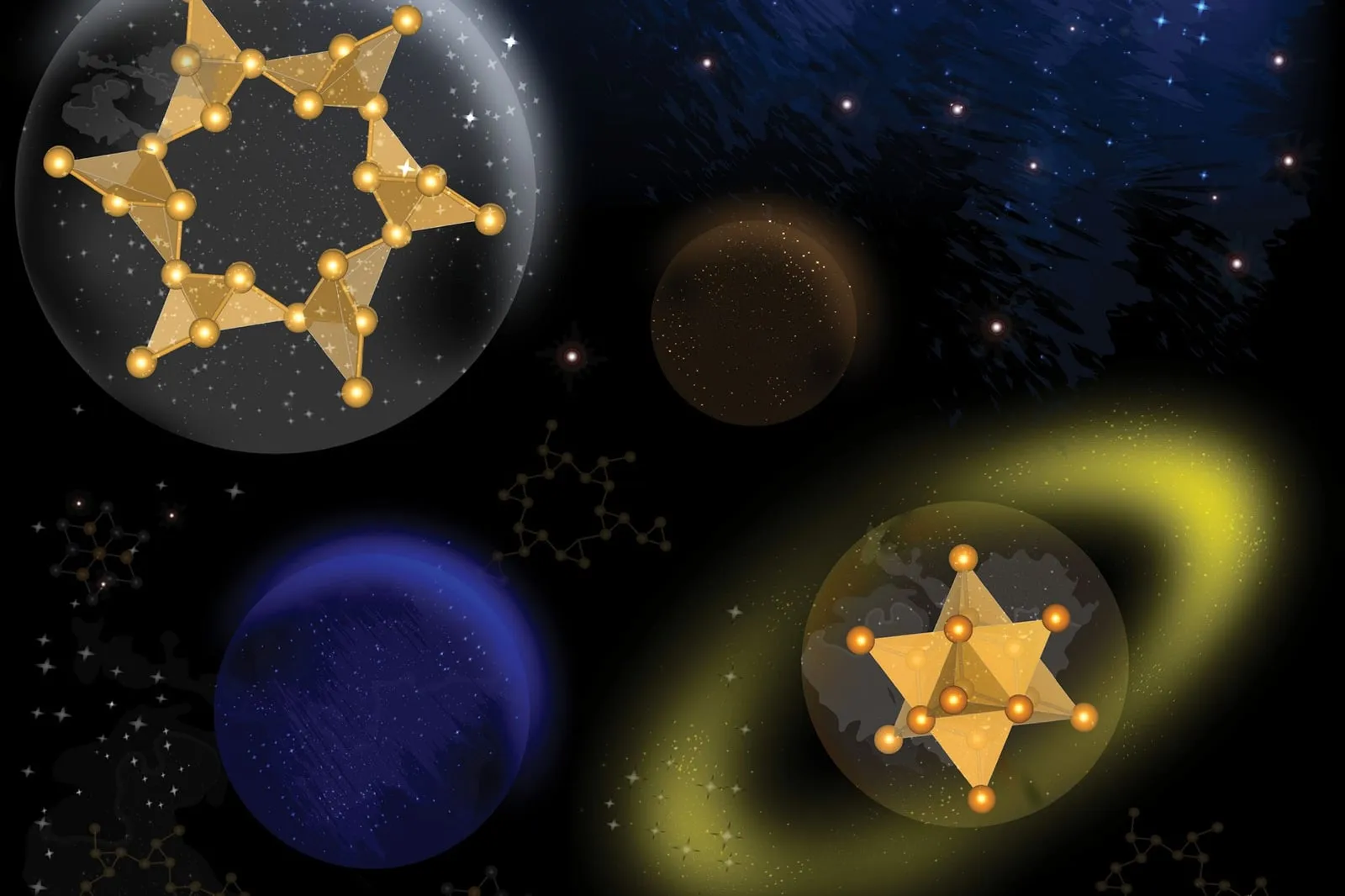
Metals are almost always found as cations. Gold and platinum are the exceptions. Relativistic contraction of the 6s orbital gives them electron affinities of 2.30 eV for Au and 2.13 eV for Pt, both larger than that of sulfur (2.08 eV). Paired with electropositive elements, they take on a negative charge and form aurides and platinides, compounds whose bonding and structures fall outside the usual rules of solid-state chemistry.
The Brgoch group combines synthesis with electronic-structure calculations to understand how these anionic metals bond. Work on the rare-earth gold tetrelides (RE–Au–Ge, Sn, Pb) has traced how gold builds polyanionic networks with the tetrel elements, and how small changes in composition twist and pucker these networks into new structure types. In the Na–Au–Cd system, the same approach followed the crystal chemistry from simple Laves phases to complex quasicrystal approximants.
Pressure offers a second way to push metals into anionic states. Studies from the group predict that alkali-metal iridides and cesium platinides become stable at high pressure, giving experimental targets that do not exist under ambient conditions. Synthesis is carried out by high-temperature sealed-tube reactions, and structures are solved by single-crystal and powder X-ray diffraction.

Funded by
 Welch FoundationE-1981