AI-Driven Discovery of New Permanent Magnetic Materials
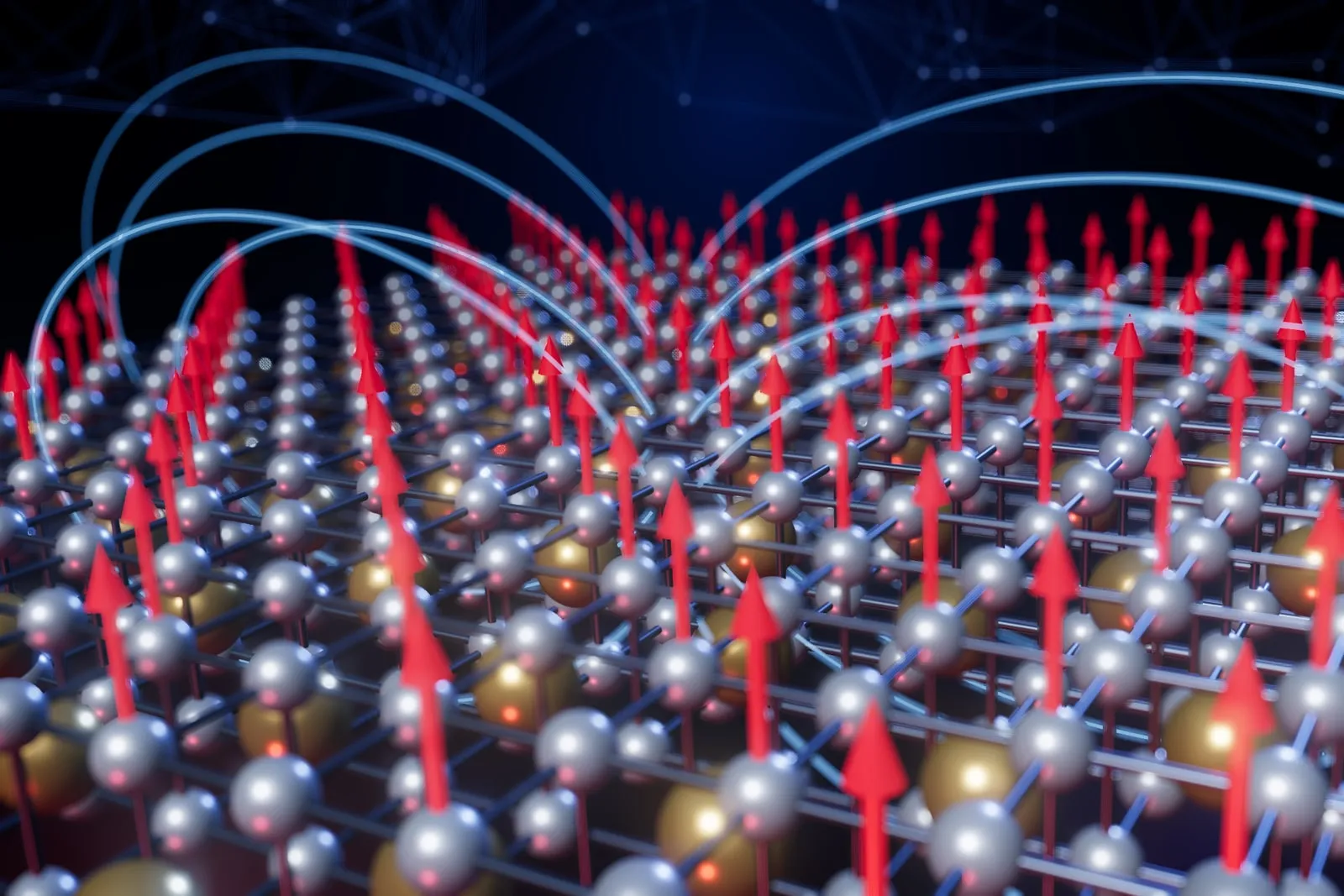
Permanent magnets sit inside every electric-vehicle motor, wind-turbine generator, and most consumer electronics. The strongest, Nd2Fe14B and SmCo5, depend on rare-earth elements with a limited and geographically concentrated supply. A useful replacement needs a high saturation magnetization, strong magnetocrystalline anisotropy, and a Curie temperature well above operating conditions, and very few known compounds have all three.
The Brgoch group leads GAMBIT (Guided AI for Magnetic Boride/Carbide Intermetallic Technologies), a project in ARPA-E’s MAGNITO program that searches for new permanent magnets among borides, carbides, and related intermetallic compounds. Machine-learning models and first-principles calculations screen large numbers of hypothetical compositions and rank the materials most likely to outperform today’s magnets, while computed reaction pathways point to the synthesis routes most likely to produce them.
Candidates are prepared by arc melting and high-temperature solid-state reactions, their structures are determined by X-ray diffraction, and their magnetic properties are measured directly. Every result, including the compounds that fail, goes back into the models so that the next round of predictions improves. The project brings together the Bocarsly group at UH, Geoffroy Hautier’s group at Rice University, Jamie Neilson’s group at Colorado State University, Newfound Materials, and Carrier Global. More at projectgambit.org.
Researchers


Funded by
 DOE ARPA-E MAGNITODE-AR0002153