Designing Persistent Phosphors for Extreme Conditions
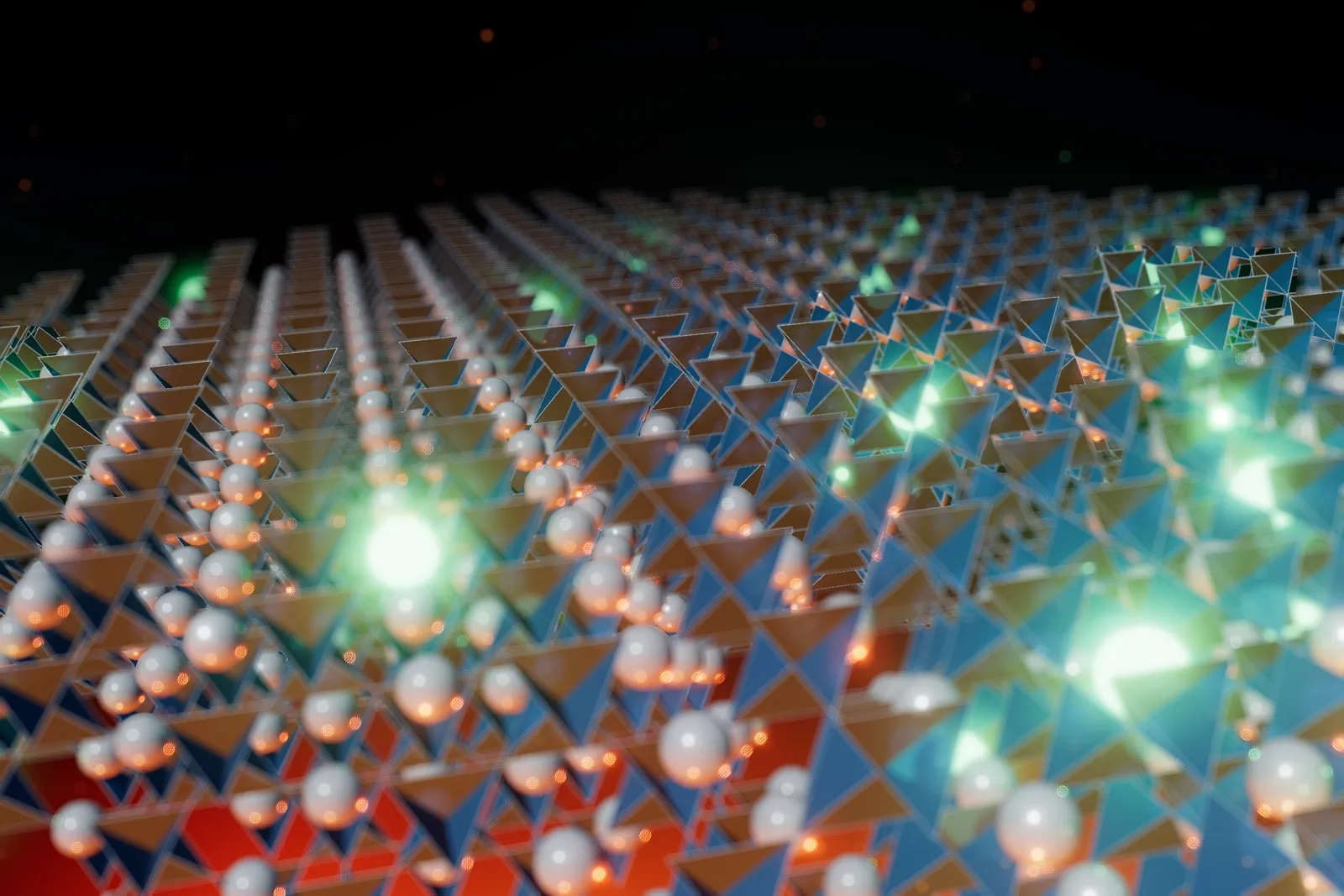
Persistent phosphors store energy in defect traps and release it as light for minutes to hours after the excitation source is removed. Nearly every known persistent phosphor is designed to work at room temperature. As the temperature rises, the trapped charge escapes too quickly and the emission quenches, so the afterglow fades within seconds. That rules out applications that need a self-sustained light source in hot or harsh settings, such as signage and optical sensors in high-temperature industrial equipment.
The Brgoch group designs persistent phosphors that keep glowing under these conditions. The work centers on the traps themselves: chemical substitution sets how deep the traps sit and how many there are, so that charge is held at high temperature and released at a useful rate. In Ca2Si5N8:Eu2+, co-substitution with trivalent rare-earth ions tuned the trap depths so that the afterglow persists at elevated temperature. Studies of SrAl2O4:Eu2+ and ZnGa2O4:Cr3+ established how intrinsic defects and cation substitution control these trap states.
New compositions are prepared by high-temperature solid-state reactions in rigid, chemically stable hosts such as nitrides. They are characterized by X-ray diffraction and X-ray absorption spectroscopy, thermoluminescence measurements of trap depth, and temperature-dependent photoluminescence and afterglow decay, with density functional theory (DFT) calculations of defect energetics guiding the choice of substituents.

